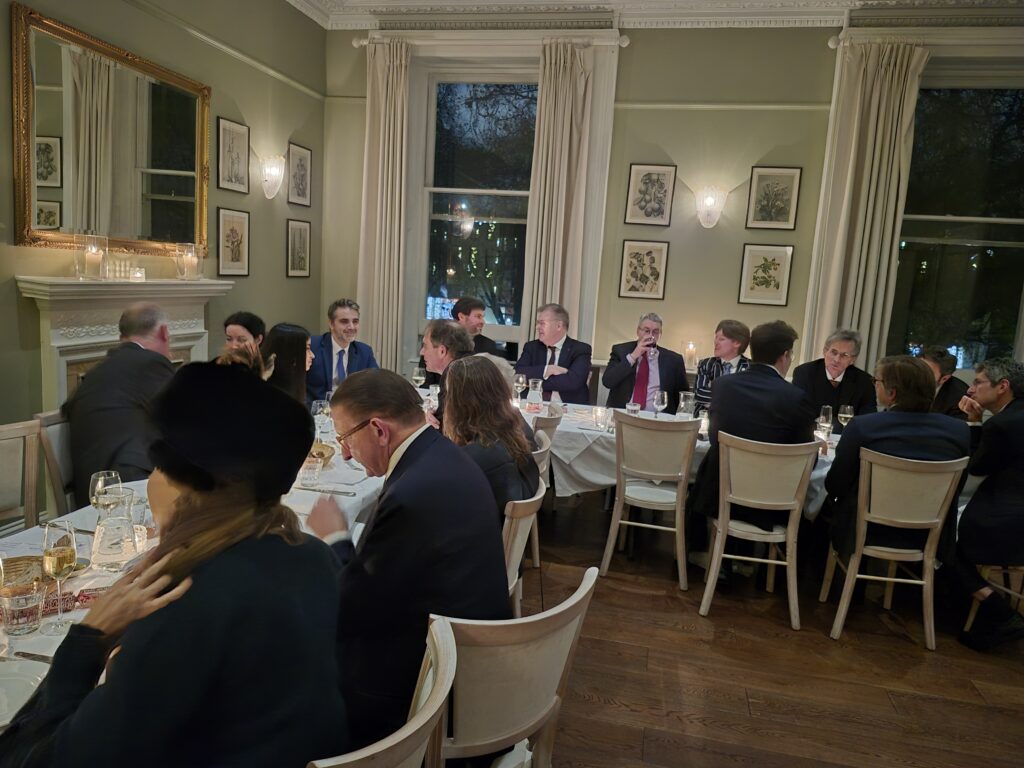
On 2nd of December, DIRDI hosted our first London Fellows dinner of the 2025/6 year, gathering scientists, economists, industrial leaders and Visiting Fellows from Whitehall under the warm lights of the Polish Club in South Kensington. With wreaths on the walls and the faint scent of mulled wine drifting from the foyer, the evening had the unmistakable feel of a Christmas reunion, only with more scientific discussion than carols.
But it wasn’t the seasonal decor that animated the room. The night’s centrepiece was a trio of short, sharp provocation talks, designed not as formal lectures but as intellectual “sparks,” each deliberately crafted to ignite debate around the dinner table.
First up was Professor Ryan Nichol of University College London. Speaking with the casual enthusiasm of someone accustomed to extreme environments, he described the surreal experience of hunting for neutrinos in Antarctica, particles so elusive that thousands of tonnes of ice and the patience of a saint are needed to spot them.
Next, Dr David Watson from King’s College London, challenged many people’s underlying assumptions: that AI is fundamentally a scientific discipline. Instead, he argued that much of the field’s most pressing work now sits within the humanities: ethics, philosophy, narrative framing, and cultural sense-making.
Rounding off the set was Dr Elena Dieckmann from Imperial College London’s Dyson School of Engineering, who offered a spirited tour through the fast-moving world of sustainable materials. She sketched a picture of a near-future manufacturing ecosystem where waste products are fully recyclable into high-value materials, producing a valuable and sustainable circular economy.
DIRDI’s Director-General also spoke on the organisation’s rapid expansion. The coming months will see the launch of the National Strategic Research Group (NSRG), along with the creation of a dedicated Strategic-Potential AI Group within DIRDI, two major steps in the institute’s evolution. These sub-units, based across leading UK universities, will offer new pathways for experts to shape both policy and long-horizon scientific strategy at a time when national capability building has rarely felt more urgent.
This London dinner was DIRDI’s third major event of the academic year, following a Fellows gathering in Cambridge and a Thin Film & Surface Physics day co-hosted with the Institute of Physics in Durham. With a greatly expanded events calendar, including a larger, AI-focused annual conference, DIRDI is poised for one of its most active years to date.
For now, though, the Polish Club dinner served its traditional purpose: a space for Fellows to test ideas, forge collaborations, and, in several cases, leave with conversations still buzzing in their ears.