
Our Research groups

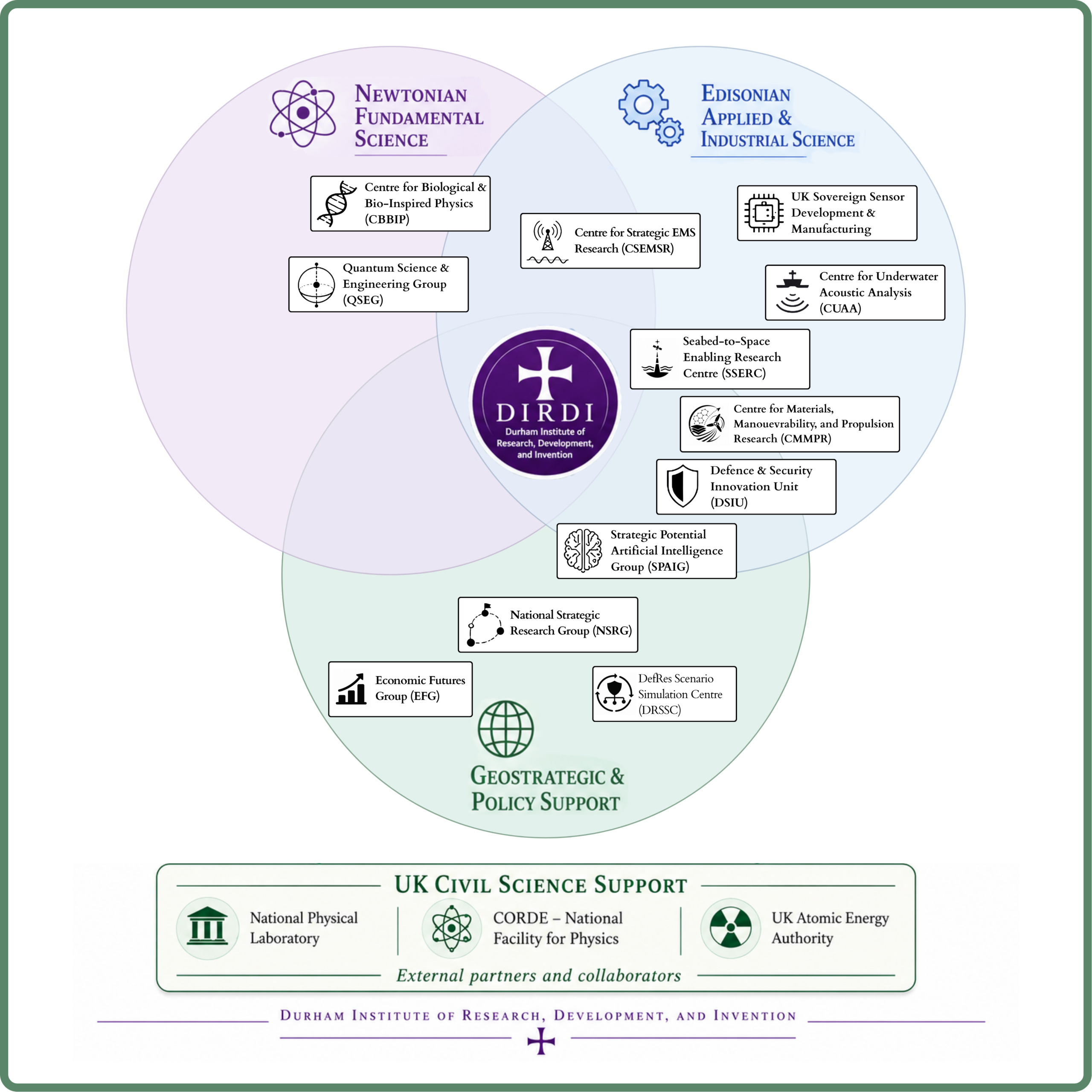
The Centre for Underwater Acoustic Analysis

'Pro Patria et Scientia'

The Centre for Underwater Acoustic Analysis conducts research on the behaviour of sound underwater, as well as the informational techniques by which received acoustic signals are processed, in order to inform the development and optimisation of novel submarine acoustic technologies.

Based at Durham University, it is tasked with regenerating capability for the Royal Navy in the underwater battlespace (UWB). There are 3 strands to its work, all aimed to generate UK “strategic technological dominance” rather than risk “oscillating operational advantage”, across the Atlantic, Pacific, and Arctic Oceans.

The Strategic-Potential AI Group

SPAIG is an AI testing & evaluation capability responsible for evaluating the potential impact of AI systems before they are introduced in UK public and private sector organisations. It provides an assessment of the opportunities and hazards associated with new AI-systems and suggests practical steps that should be taken to mitigate any associated risks.

Defence and Security Innovation Unit (DSIU)

The Defence and Security Innovation Unit (DSIU) accelerates high-impact technologies for UK Defence and National Security by integrating world-class research, rapid prototyping, and sovereign manufacturing. It provides an end-to-end pathway, from idea to deployable capability, that closes the UK’s longstanding gap between research excellence and deployed technology. Positioned within DIRDI and aligned with UK Defence Innovation (UKDI), DSIU supports His Majesty’s Government (HMG) to generate fast, resilient, and strategically dominant technological capability.

DSIU is nominally based at Imperial College London and focuses on the following priority areas.

  1. Advanced Materials
  2. Artificial Intelligence
  3. Biotechnology
  4. Critical National Infrastructure
  5. Cyber and Communications
  6. Electromagnetic Spectrum
  7. Electronic Engineering
  8. Energy and Power
  9. Hypersonics
  10. Maritime Operations
  11. Photonics
  12. Quantum Technologies
  13. Space Research
  14. Underwater Acoustics

The Centre for Strategic Electromagnetic Spectrum Research (CSEMSR)

The mission of CSEMSR is to support the UK Government to develop fundamental electromagnetic capabilities to deliver strategic advantage in the electromagnetic domain. it is based at the Cavendish Laboratory in Cambridge.

The electromagnetic domain is essential for strategic military capabilities in a “seabed to space” era, such as communication, navigation, and the control systems underpinning the UK’s critical national infrastructure and it is vital to national security and economic prosperity. Therefore, dominance of the electromagnetic domain at a transcontinental level is of strategic importance, not merely to prevail in times of conflict, but to deter it altogether.

CSEMSR will identify and advance fundamental technologies that, if successfully developed and applied, could have a transformational effect on the strategic application of the electromagnetic spectrum.

Following James Clerk Maxwell’s theoretical work in 1865 and Hertz’s experimental confirmation in the 1880s, practical wireless communication emerged between the 1890s and 1920s. A second wave of breakthrough innovation came during the Second World War, driven by the development of radar and high-power microwave sources. The late twentieth century saw further transformation through advances in transistor and laser technologies, which opened new operational domains. From the 1990s onward, progress in software and cellular standards has delivered steady, incremental improvements in electromagnetic systems and integration. Today, there is a wealth of emerging research in UK Academia across areas such as metamaterials, terahertz science, integrated photonics, and quantum sensing that offers the potential for another strategic leap in electromagnetic capability.

The National Strategic Research Group

Convening the UK’s finest minds to deliver fast, synthesised, and practical answers to complex questions for national strategy, giving policymakers time-effective access to the leading edge of research.

The National Strategic Research Group (NSRG) is designed to support senior policymakers in Whitehall with problems that would benefit from senior specialist external engagement. The NSRG provides a public-service-led mechanism to augment senior decision-makers' capacity by giving structured access to expert insight from industry and academia. Its purpose is to help 1–4-star leaders address the most challenging questions in national security and national strategy. Through the NSRG, policymakers will be able to draw on world-class expertise to shape solutions to issues spanning foreign, defence, security, and resilience policy, as well as fiscal, economic, and social considerations. In doing so, the Group ensures that expert voices are heard at the highest levels and can help inform the long-term strategic direction of the UK.

Based at Pembroke College, Oxford, the NSRG focuses particularly on the questions that underpin the UK’s domestic stability, security, and prosperity within a long-term national strategy. It brings together government, industry leaders, academia, and defence to mobilise the UK’s hard and soft-power resources in a coordinated national effort. This reflects the scale and complexity of modern threats and supports the ambition to develop a non-partisan, national strategy fit for the 21st century and capable of enduring into the 22nd century.

Further to this, the NSRG aims to develop a joint intellectual ecosystem between HMG and British academia. By bringing policy challenges directly into the academic domain and supporting research aligned with national need, it will help shape the capabilities, curricula, and talent pipelines that underpin Britain’s future intellectual capital and long-term strength. This collaboration ensures that tomorrow’s strategic leaders emerge with the insight, agility, and strategic confidence demanded by an ever more complex world.

For more information please contact luciana.garstang@dirdi.org.