The fourth Impact & Invention Conference
Quantum Technologies From Discovery to Delivery
Cavendish Laboratory, Ray Dolby Centre, University of Cambridge
Register AttendanceHow will advances in quantum science accelerate discoveries in other fields and unlock new opportunities across industry?
Our conference follows emerging quantum technologies out of the laboratory and into manufacturing, commercial use and national capability.
It explores how the unique features of quantum mechanics can unlock new insight and capability in biomedicine, chemistry, geology, oceanography, mathematics, computer science and physics.
Keynote
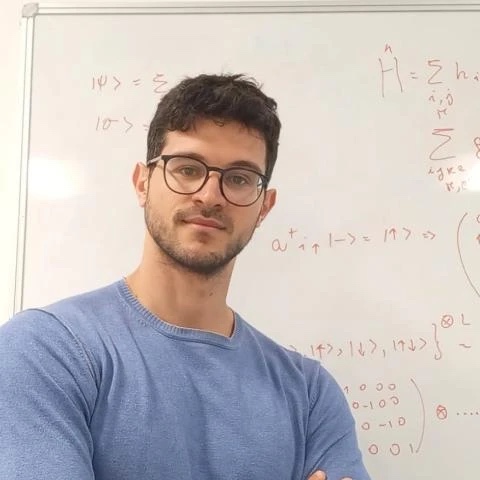
Dr Emanuele Marsili
Senior Scientist and Quantum Technologies Expert, Airbus Central Research & Technology
As quantum technologies transition from theoretical promise to practical implementation, bridging the gap between foundational algorithms and real-world industrial impact requires an end-to-end operational framework. This keynote explores how quantum computing can be systematically integrated into complex industrial engineering workflows, moving beyond isolated algorithm benchmarks to address multi-scale, multi-physics challenges in aerospace and advanced manufacturing.
Read the full abstract
We present a comprehensive top-to-bottom paradigm for embedding quantum acceleration within high-performance classical pipelines. Using aerospace materials science and corrosion modeling as a primary exemplar, specifically capturing localized electrochemical dynamics and strongly correlated surface electronic states on aluminum alloys, we demonstrate how continuum-level models (such as finite element analysis) can be tightly coupled with quantum chemistry algorithms. Grounded in rigorous resource estimation for methods like Quantum Phase Estimation (QPE) and quantum embedding, we evaluate current algorithmic scalability, hardware constraints, and fault-tolerant timelines relative to state-of-the-art classical computing capabilities.
Our findings underscore the essential role of quantum–classical hybrid workflows in enabling practical quantum computing use cases. Moreover, they demonstrate that advancements in quantum hardware must be paralleled by breakthroughs in algorithm design and quantum error correction (QEC) to realize the full potential of quantum computing in materials science. This study represents the first fully integrated, multi-scale quantum-classical simulation of corrosion, laying critical groundwork for future materials design strategies that merge continuum-level modeling with quantum-accurate atomistic insights.




Poster competition
We welcome submissions from across all disciplines, interpreting the conference’s theme in its broadest sense. Those wishing to participate are asked to register their intention to submit a poster by 18 December 2026.
Register your intention by
Register to submit a posterVenue
Cavendish Laboratory, Ray Dolby Centre
University of Cambridge
JJ Thomson Avenue, Cambridge CB3 0US Map (opens in a new tab)